About Me

My photo
Hello, my name is Valorie. I have a Master's Degree in History and a license to teach-- I have been both university professor and public school teacher. Currently, I am a middle school social studies teacher. I love horror movies and spooky things. Every day is Halloween. I am also a passionate book blogger.

Featured Post

Book Review: 23:27 by H.L. Roberts

Showing posts with label middle ages. Show all posts

Thursday, August 3, 2017

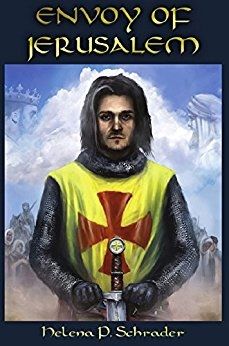
Promo Blitz: Envoy of Jerusalem by Helena P. Schrader


Historical Fiction
Date Published: August 2016
Publisher: Wheatmark

 photo add-to-goodreads-button_zpsc7b3c634.png


Winner of the Pinnacle Award 2016 for Biographical Fiction, the Feathered Quill Award 2017 for Spiritual/Religious Fiction, and a Foreword INDIES Award for Military/Wartime Fiction.

Balian has survived the devastating defeat of the Frankish army at the Battle of Hattin, and walked away a free man after the surrender of Jerusalem, but he is baron of nothing in a kingdom that no longer exists. Haunted by the tens of thousands of Christians now enslaved by the Saracens, he is determined to regain what has been lost. The arrival of a vast crusading army under the soon-to-be-legendary Richard the Lionheart offers hope -- but also conflict, as natives and crusaders clash and French and English quarrel.

Other Books in the Balian d'Ibelin Series


Knight of Jerusalem
Published: September 2014

Balian, the landless son of a local baron, goes to Jerusalem to seek his fortune. Instead, he finds himself trapped into serving the young prince suffering from leprosy, an apparent sentence to obscurity and death. But the unexpected death of King Amalric makes the leper boy King Baldwin IV of Jerusalem, and Balian’s prospects begin to improve.

The Byzantine princess Maria Comnena is just thirteen years old when she arrives in the Kingdom of Jerusalem at her great uncle’s orders to cement the alliance between the two Christian kingdoms in the East. The child wife of a man almost three times her own age, she is despite her excellent education and intelligence little more than a pretty doll in the eyes of her husband. When she fails to produce a male heir for the desperate king, her marriage becomes a gilded prison. Until suddenly the king is dead and Maria finds herself a wealthy widow at just twenty years of age.

Meanwhile, the charismatic Kurdish leader Saladin has united the forces of Islam and vowed to drive the Christians into the sea. While King Baldwin IV—and Balian—struggle to save the Holy Land for Christendom by whatever means they can, the internal rivalries of Templars and Hospitallers, the advocates of offense and defense, and the bitter rivalries of barons threaten to tear the kingdom apart.


Defender of Jerusalem
Published: July 2015

The Christian kingdom of Jerusalem is under siege. The charismatic Kurdish leader, Salah ad-Din, has succeeded in uniting Shiite Egypt with Sunnite Syria and has now declared jihad against the Christian kingdom. While King Baldwin IV struggles to defend his kingdom from the external threat despite the increasing ravages of leprosy, the struggle for the succession threatens to tear the kingdom apart from the inside. In the high-stakes game, one man stands out for his loyalty to the dying king, the kingdom, and Christianity itself. That man is Balian d'Ibelin.

This is the second book in a three-part biographical novel about Balian d'Ibelin, who defended Jerusalem against Salah ad-Din in 1187. The first book in the series, Knight of Jerusalem, was a finalist for the 2014 Chaucer Award for Historical Fiction and a B.R.A.G. Medallion Honoree.


About the Author


Helena P. Schrader earned a PhD in History from the University of Hamburg with a ground-breaking biography of a leader of the German Resistance to Hitler. She has published numerous works of fiction and non-fiction since.

Her Jerusalem Trilogy, set in the Holy Land in the late 12th century, has won critical acclaim.

Contact Links


Purchase Links


Reading Addiction Blog Tours

Monday, July 24, 2017

Book Review: Fairly Certain by Deborah Ann Davis


About Fairly Certain

Young Adult Romantic Suspense
Date Published: September 2015
Publisher: D&D Universe, llc

What happens when a Computer Geek challenges a Medieval Outlaw?

PETIR TAKES A ROUGH TUMBLE IN THE CONNECTICUT WOODS, and awakens in the middle of old England. His instinct to freak out is tempered by the arrival of a fair maiden wearing a bow… and arrow. In his college world, fair maiden types don’t ordinarily go for computer geek types, but for some reason he is no longer in his world. Petir is fairly certain he can try whatever he wants without consequence.

WITH THE CONFLICT BETWEEN THE ROYALS ESCALATING, MAID RIANNE has joined the outlaws hiding in the woods, outwardly defying the handsome and accomplished knight to whom she is promised. She is fairly certain she is simply flattered by Lord Petir’s uncensored admiration of her skills with the staff and bow, the same unmaidenly pursuits disdained by her knight. But, that does not explain her reaction to Lord Petir’s unguarded gaze.

TO PETIR’S DELIGHT, AND MAID RIANNE’S DISMAY, the outlaws invite him to join their merry band. What better way to get close to her? Throwing caution to the wind, Petir decides he has nothing to lose by pursuing Maid Rianne, until she is captured by the enemy. Now, a geek with no ability to defend himself must find a way to rescue the fair maiden.

About Fairly Safe

Young Adult Romantic Suspense 
Date Published: August 2016
Publisher: D&D Universe, llc

When Mistaken Identity collides with Secret Identity, who wins?

JACOB HAS COME A LONG WAY FOR AN ORPHANED KID. He has a mentor, a great job, and has finally fallen in love. Granted, she mistook him for a stalker when they met, but every relationship has its little problems. Unfortunately, for the past few years, as the object of his affection pops in and out of his life, she has refused to share any personal info, like where she’s from…or her real name. Regardless, Jacob is ready to take their relationship to the next level. Now, if only he can locate her so he can tell her.

CASEY’S FAMILY IS IN THE WITNESS PROTECTION program. Safety has to be their only priority. Their cover has been blown before, so Casey knows at any given time they could be forced to disappear again. Obviously, a shy young man with hopeful eyes cannot possibly be added to the mix. Now, if only she can stop thinking about him.

JACOB’S AND CASEY’S WORLDS UNEXPECTEDLY COLLIDE when Jacob inadvertently helps hide her family. Exposed to their 24/7 vigilance, Jacob realizes he must come up with a plan to keep them out of harm’s way, because this time if Casey disappears, she will be taking with her Jacob’s heart, and his hopes of finally having a family of his own.


Review of Fairly Certain
Petir is just your average young man who takes a solo trip to go geocaching. An unfortunate fall from the tree finds him in medieval England, the unwitting companion of a Robin Hood band of folks, but Robin Hood with a twist. There’s Friar Tuck, who is not a Franciscan friar but rather a cook, and no Robin Hood, but rather Maid Rianne. The story is very similar: they dislike the policies of the ruler Prince John and his Sheriff, supporting the good King Robert, who is away at war, and his claim to the throne.

Maid Rianne struggles against the confinement of the “woman’s place,” as she is a skill warrior who leads the band of “merry men.” Petir is just a normal modern boy with absolutely no idea how to fight. But he goes along with being captured and taught the various ways of hidden outlaws. Even though fighting is not his strong point. But one thing is sure: he is smitten with Maid Rianne. And she is rather taken with him, too, though she is engaged to a noble named Lord Robert, who she takes two issues with. The first, he doesn’t value her warrior skill, and two, he supports the Sheriff and Prince John. However, Rianne is a woman of honor and is not so ready to betray her betrothed. Robert, however, takes no qualm with betraying her for favor with the corrupt, tyrannical court.

Half of the book is about Petir learning the various ways of the outlaws: their rules, their food, their customs, even their eating. And let’s not forget, swooning over Maid Rianne. Then large seconds dedicated to Maid Rianne swooning over Petir. You’re pretty much rooting for them and it seems obvious to the reader that the two of them will end up together, though how that will work when time travel is involved is a mystery.

But there is a clever surprise waiting at the end that will leave you laughing and smiling, and ultimately happy for all of the characters involved.

I thought this story was charming and well thought out. It’s good to read a story that takes a traditional tale and gives it a little bit of a twist. The details of the book wee cleverly thought out, and the fusion of lore with modern convention really worked in such a way that they wove a charming story. It’s a lighthearted romance with a happy ending, and who doesn’t love a story that leaves you feeling warm and satisfied?

Excerpt From Fairly Certain:
Maid Rianne leaned over and rested a cool hand on his brow. Petir’s mouth went dry.

“Does your head pain thee, m’lord?” she asked, her face troubled.

“A little. I…uh, not much. I mean, it was, but now it...it’s....” Maid Rianne squatted next to him and gently ran her fingers through his hair. That had never happened to him before.

“Enough talk, m’lord,” she instructed. “You should rest.”

Whatever you want, Maid Rianne. Petir fell silent, relishing her touch. It was glorious. This was turning out to be an excellent dream. He felt wonderful. He felt bewitched. He felt—

“Yow!” he yelped. “What was that?”

“M’lord, you have quite a bump here, but no bleeding. You must have hit your head when you fell.”
Jeez. That really hurt. He winced as he inspected the site himself.

Maid Rianne put her palms on either side of his face and turned him to look at her. Petir froze. A patch of sunlight beamed down between the trees behind her, creating a halo effect around her face. She moved her head slowly side to side, allowing the sun to splash across his face as she moved. She stared long and searchingly into his eyes. He stopped breathing, his pain unceremoniously shoved to the back seat.

She cleared her throat and released his face. “Your eyes show no ill effects from the blow, m’lord.” She held up three fingers. “How many do you see?”

She was only checking his vitals? He almost laughed aloud at his mistaken read of her actions.

“M’lord?”

“Oh! Uh, three.”

“All appears well, m’lord, but you should be watched ‘til the next dawn.”

“Who...” Petir licked his dry lips and tried to swallow in his dry throat. “Who will watch me?”

“The ’ealer, of course, yer lordship,” piped up the redheaded boy.

What the hell is an eeler?

“Hey, Red, what’s your name?” Petir asked.

The kid gave Petir a cheeky grin. “They call me Cord, m’lord.”

“Okay, Cord, what’s an eeler?”

“Why, a person who tends to wounds and ’eals the sick, sir.”

“Okay, wait. Do you mean a healer?”

“‘Tis what I said, sir.”

“Yea, verily,” said Maid Rianne, smoothly standing while rubbing her hands on her pants.

I hope my hair’s clean. Petir touched the lump on his skull as he watched Maid Rianne rejoin the boys. Baggy clothes or not, she was kicking the warrior maiden thing.

A stretcher with a yoke took shape under the boys’ industrious hands. Using vines, they secured the smaller branches between two larger limbs. A third ran perpendicular to the first two. They worked quickly, speaking in hushed tones, occasionally glancing over their shoulders into the forest, as if dreading unwanted company. Petir followed their gazes, wondering what caused their concern. Should he be worrying, too?

Eventually they lifted the stretcher and carried it to Petir. It looked uncomfortable and unstable.
“I’m not getting on that.”

“Oh, but you are, m’lord.” Maid Rianne’s voice was calm but firm. “Consider your limited options.” She began counting on her hand. “You may get on, be blindfolded, and be carried to our camp. Or,” her sarcastic words belied her sweet smile, “you can try to walk to the camp blindfolded, which I do not recommend.”

“Or you can find your own way back from whence you came.” She paused, solemnly gazing at him over three fingertips. “Tell me, m’lord. Do you know where you are?” She arched her brows at his frown. “I thought not.” She folded down one of her fingers with feigned politeness.

“I know where I am. I’m in a damn nightmare,” he growled. Hottie or not, she was beginning to piss him off.

“Or, m’lord, you could simply remain here until you heal, then leave on your own accord.” The finger reappeared while she regretfully feigned a sigh. “Such a difficult decision is yours.”

The boys giggled, not the least bit cowed by Petir’s glare.

“Your decision, sir?” Maid Rianne asked, her features schooled into exaggerated patience.

“Fine!” snapped Petir. “I’ll ride that thing, but I am not wearing a blindfold.”

“No blindfold? As you wish, m’lord.” Maid Rianne lowered two fingers. “However, that reduces your choices by more than half. Shall ye be spending the night here, or making your way back?”

That was cold. He looked at the boys, who were now avoiding his gaze. The smallest kid was actually wringing his hands while he looked back and forth between Petir and Maid Rianne.

Petir’s head resumed its pounding in double time. Perhaps he needed to rethink his stance. After all, if this was a dream, it didn’t matter if he went or not. Refusing the blindfold, however, could result in Maid Hottie exiting the dream permanently. That would suck. Unless another hot maiden put in an appearance.

But, what if it wasn’t a dream? He still didn’t know where he was, and unless some bars magically appeared on his cell phone, he was going to end up sitting on his butt in the woods another night. Not to mention, he didn’t know where his cell had gone.

On the other hand, maybe these kids came from some kind of psycho cult and were hiding out. The deranged always acted suspicious in the movies. “Nope. I’m not wearing the blindfold. I don’t know you people. For all I know, you could-”

“Oh, please, sir! Accept the blindfold!” cried the small boy.

Petir blinked, his unease growing. The boy’s angst was contagious. Cord touched Maid Rianne’s arm. “Please, mistress, we cannot leave him here.”

“We can, and we will,” she replied, shaking him off. “I, for one, am not willing to betray our cause simply because a stranger refuses a blindfold. Are you?” She leaned forward. “And what if this is nothing more than an elaborate plot to reveal our whereabouts? Men, women, and babes—all sacrificed for a moment of kindness. Your family. Their families….”

The boy’s head dropped as he stepped away from her and closer to Petir. “’Tis not right, mistress. It is just not right,” he muttered.

Maid Rianne straightened. “May I suggest ye head back to the camp and ask for a volunteer to help bring this stranger to the nearest town? Perchance there be one who is willing to risk capture and spending the remainder of his days as a guest of the sheriff. But not I.” She strode to Petir. “Your final decision, yer lordship?”

“Please, m’lord.” Cord ran over and squatted next to him. “Ye be better off with us. I will not let any harm come to ye.”

Petir closed his mouth, which had somehow started hanging open again, and regarded the distraught young face. This kid was going to protect him? He probably didn’t even reach Petir’s shoulder.

About the Author

I currently reside in lovely Connecticut where I enjoy dabbling with living a sustainable life, developing my Girl’s Guide To Good Guys: The Power of Being Patient & Picky program to promote an empowering way for teenage girls to see themselves, writing novels for my Love of Fairs series (Fairly Obvious will be out in 2017), dancing, playing outside, and laughing really hard every day. I promote increasing the amount of movement throughout your day via Wiggle Writer posts on my blog, Merry Meddling, and on Twitter @WiggleWriter and @DeborahAnnDavis.


Contact Information
Website: http://deborahanndavis.com
Facebook: https://www.facebook.com/DeborahAnnDavisAuthor/
Twitter: @WiggleWriter and @DeborahAnnDavis.
Blog: http://deborahanndavis.com/merry-meddling/
Pinterest: https://www.pinterest.com/WiggleWriter/
Goodreads: https://www.goodreads.com/author/show/9220018.Deborah_Ann_Davis
Author on GoRead.com: https://www.goread.com/buzz/deborah-ann/

Fairly Certain Purchase Links
Amazon: https://www.amazon.com/Fairly-Certain-Fairs-Deborah-Davis-ebook/dp/B01AOMUNM8/ref=tmm_kin_title_0?_encoding=UTF8&qid=1480353208&sr=8-2
Barnes and Noble:  http://www.barnesandnoble.com/w/fairly-certain-deborah-ann-davis/1120492765?ean=9781942009030
Kobo:  https://www.kobo.com/us/en/ebook/fairly-certain
iBooks: https://itunes.apple.com/us/book/fairly-certain/id953643118?mt=11

Fairly Safe Purchase Links
Amazon: https://www.amazon.com/Fairly-Safe-Deborah-Ann-Davis/dp/1942009054/ref=sr_1_1?ie=UTF8&qid=1480351529&sr=8-1&keywords=fairly+safe
Barnes and Noble: http://www.barnesandnoble.com/w/fairly-safe-deborah-ann-davis/1123106502?ean=2940152504552
Kobo: https://www.kobo.com/us/en/ebook/fairly-safe
iBooks: https://itunes.apple.com/us/book/fairly-safe/id1146967326?mt=11


Saturday, July 27, 2013

Book Review: Immodest Acts- The Life of a Lesbian Nun in Renaissance Italy by Judith C. Brown


Title: Immodest Acts: The Life of a Lesbian Nun in Renaissance Italy 
Author: Judith C. Brown 
Genre: Nonfiction - History

While perusing the scattered archival documents of a Miscellanea Medicea file housed in the State Archive of Florence, Judith C. Brown came across a series of scattered documents relating to the interrogations of one Ms. Benedetta Carlini, Abbess of the Convent of Mother of God.  Benedetta Carlini was a self-diagnosed mystic, in direct communication with Christ, in fact the very bride of Christ, and the supposed recipient of one of Heaven's highest blessings: the stigmata.  However, due to her own hubris and often abusive and inflated self-importance, the holes in Benedetta's claims began to be exposed.  Beginning in 1619, a series of investigations were undertaken by ecclesiastical authorities to prove the validity of her claims.  Eventually, not only was it proven that Benedetta Carlini had faked her mystic powers, but that she had engaged in a lesbian affair with another nun under the guise of an angelic deity, Splenditello. Brown's novel is so very valuable as a historical source because lesbianism is rarely found in historical sources.  For an early modern (and before) historian, female gender and sexual histories are complicated when found in source material due to contemporary culture and religious beliefs.  Theologians, the writings of whom are by far the most prevalent of documents and sources to be found of the early modern period, had a hard time coming to terms with lesbianism.  Many of them merely believed that no such thing could exist.  Others insisted that the lack of a penis, the only essential part in copulation, made any instance of lesbian sex not sex at all.  There were a plethora of theories about what sex was, what made sex real, and what role both women and men played in the act.  In the preface to Benedetta's story, Brown manages to sum up some of the most important theologians of and before the events of the book, and these theologian's ideas about sex.  For scholars and students of sex and sexuality, Brown's very succinct synthesis of the historical religious views surrounding sex is very useful. Yet let me say that if you are looking for an earth shattering book on early modern lesbian, you will be disappointed.  The "lesbianism" of Benedetta isn't discussed until the very last section when he undergoes her final investigation.  

Really, the book is less about a lesbian nun navigating a very restrictive and strict religious world, and more about a failed mystic who used her power to falsify miracles and lie about the personal relationship she had with Christ and various angels to elevate herself in the monastic community in which she lived.  Beyond the very small spattering of lesbian conduct, Benedetta's life is far more illustrative of a single woman's psychological need for recognition, and to be extraordinary within a community of similarity and similar sacrifice.  After all, how does one show that they are superior to their religious equals?  Show that they are chosen by God or by Christ for miracles and recognition. What I loved the most about the book, though, was the process of investigation underwent by Benedetta.  I loved reading the questions asked, and how she responded.  I loved reading about the miracles she claimed, and then further in the book how the lies behind them unraveled as her fellow sisters began to come forth with the truth.  Again, this is more the story of a woman who rises in ranks within her very small and limited monastic world, has her lies and deceits exposed, and finally falls into obscurity.  As far as microhistory goes, this book is one worth reading.

Sunday, March 17, 2013

Book Review: Pope Joan by Donna Woolfolk Cross


Title: Pope Joan 
Author: Donna Woolfolk Cross 
Genre: Fiction- Historical 
Rating: 3 Stars

Pope Joan (John) is a figure of religious and historical controversy, most notably since Jan Hus used her supposed tenure as pope to delegitimize the succession of popes to his time. In context, this was the beginning of the Protestant Reformations, and Hus was himself one of the early reformers, dying almost 100 years before Martin Luther wrote his 95 Theses.  Before Hus, Pope Joan lived in legend and in a scattering of chronicles of the 13th century, which, by virtue of the separation of four hundred years, makes these poor sources for facts of the 9th century. And any careful historian knows to take with a grain of salt the stories told in myth and legend because unless we can accurately pinpoint their origin, it is arbitrary and often false to assume without careful examination (after all, conclusion needs to come from somewhere) of a multitude of trustworthy sources.

There is a lot to the argument that Pope Joan has been removed from the historical record by her predecessors who felt her short-lived time on the throne of St. Peter, in typical misogynist fashion, was a smear on the history of the church. God knows (no pun intended) that there have been plenty of such things attempted in the past, though historians are fortunate to have sources other than official church records to flesh out the past. Unfortunately, with Pope Joan, all we have are later accounts, four hundred years or later.  Can we trust the words of people who did not witness the event? Can we trust a footnote added to a papal record that has been dated to almost eight hundred years later?

Can we assume that later church historians moved the death of Leo IV forward by two years to leave no gaps between him and his successor (Benedict III)  Again, a no, then a pause with a maybe, and then another no.  Because we do have letters written, scant and few, that speak of the direct succession of Benedict III after Leo IV, and I doubt these simple letters were written in an attempt to further a conspiracy since they would have had no reason to (it was a simple petition matter).

Because we fact based as we like to insist we are, we do know that everything originates somewhere.  Often times, this is in legend or in an oral history, which is part of the transmission of history and legend. So simply put: did Pope Joan really live?  The answer is, no one knows and with the material in place, no one can legitimately say she did. Yet, no one can legitimately say that she did not.
But let us get on to the meat of the book.

Pope Joan is a book of historical fiction situated in real life historical events.  Many of the characters did, in fact exist, and many of the events that take place did, in fact, happen.  I always love reading historical fiction that is well grounded in historical fact because it makes the story come alive in a way that I can, at least for that moment, pretend that the events are real.  It is impossible for Cross to know anything about Joan's life, sadly, so much of it is made up.  Yet Cross clearly did her research because she is able to capture the time, in spirit and in culture, very nicely.  One of the problems with historical writers is that they want to prove they are scholars and overwhelm the reader with historical fact.  Cross, thankfully, knows where to stop. If anything, the book wonderfully captures contemporary ideas about women, the female body, and women's place not only in the world, but also in heaven.  Feminist historians and people interested in women's history should read this book to understand the woman in the Medieval world.

The story follows the life of Joan, first as a young and intelligent girl whose education is stunted by a father who sees no value in teaching a girl.  Culture, custom, and even religious belief rejected the education of the female.  It was a tough uphill battle for little Joan who overcomes the patriarchal world that she lived in to first become a monk, using the name of her dead brother, then a friend and friend and physician to the Pope, and then finally becoming Pope herself.  There is, of course, also a love story, which is as far as I know an invention entirely of Cross.  Though there is some precedent for the romance since even in the legends of Joan, she supposedly was discovered to be a woman when she gave birth.

However, one thing I wish, and this is just a personal preference, is that there was not so much untranslated Latin.  Your average reader isn't going to know what is being said, and even if they were to Google translate the phrase, it isn't likely to be accurate enough to help understanding. This is not always important for the plot, of course, but sometimes it would help reader comprehension, especially because sometimes Joan comments on the spoken Latin to emphasize the lack of education epidemic amongst the priesthood, and a reader who does not know Latin will not know the error made.  It would just make the novel more accessible to the average reader.

I thoroughly enjoyed the book, and was happy to read that Joan, at least in this version, came to a more noble end than the Joan that has persisted in Medieval and Renaissance myth (some say she was stoned to death, others that she was tied to the back of a horse and drug to her dead).  If anything, Pope Joan as a novel will stand next to the other works of fiction and myth that have existed though the ages as yet another great telling of a legend that some people love and other people hate.

Monday, March 1, 2010

Book Review: The Night Battles: Witchcraft and Agrarian Cults in the Sixteenth and Seventeenth Centuries by Carlo Ginzburg


Title: The Night Battles: Witchcraft and Agrarian Cults in the Sixteenth and Seventeenth Centuries
Author: Carlo Ginzburg 
Genre: Nonfiction - History 
Finished: March 1, 2010

In The Night Battles, Carlo Ginzburg looks at a small group of northeastern Italian people from the area of Friuli who claimed to be 'benandanti.' The benandanti, according to their legend, were people born with "the caul," and battled witches to protect the harvest and people, and to heal people bewitched. A second strand of benandanti claimed to be witness to processions of the dead. Using a small set of inquisition documents to do his microhistory, Ginzburg claims that he can reconstruct the progression of benandanti identity from their perspective from those who battle witches to those who are witches. This new identity was imposed, according to Ginzburg, by the inquisitors who used leading questions and other devices such as fear to convince the accused benandanti into altering their confessions to fit the new model of witchcraft, which can be traced through the confession transcripts. The book contains four chapters and an appendix with a few of the transcripts included for reference. Chapter one introduces the benandanti, their beliefs, and the inquisitors; chapter two describes the benandanti who associate with the dead and traces possible links of origin; chapter three returns to the benandanti and the inquisitors, and to the evolution of the benandanti identity; and chapter four sees the conclusion of the benandanti fitting themselves into the accepted mold of witchcraft. There is no way Ginzburg can support, with his available evidence, what the true intentions of the benandanti were when they confessed to witchcraft practices. Was it that they became convinced of their own evil, or simply became indoctrinated out of fear and insistence to change stories to fit what they knew the inquisitors wanted regardless of what they knew to be truth? There is simply no way to know if the benandanti were only saying what they felt needed to be said, or if they actually accepted it as truth. Ginzburg does, unfortunately, make a lot of claims that cannot be substantiated. For example, he tells the story of a woman named Anna la Rossa who he admits never claimed to be a benandanti (35). Yet later on, Ginzburg refers to her as one of the benandanti (41 & 43) without ever proving that she was one. If anything, Ginzburg is merely reasserting that many different beliefs had origins in the same pagan traditions, or that ideas filtered through geographical space. In another case, Ginzburg claims that the trances during which benandanti left their bodies were ointment induced or caused by illness (59). Again, this is not something he can adequately support and therefore cannot state it as unquestionable. Regardless of this, Ginzburg's greatest achievements are two. First, he does a good job in his outlining of the various pagan traditional origins of witchcraft and other cults. Second, he has great success in showing how the inquisitorial process was able to impose beliefs with such effectiveness that people would admit to them even when they knew giving the answer that was desired would surely bring harm to them. It sheds light on the nature of the witch hunts and trials, and the confessions rendered.

Wednesday, September 30, 2009

Blog Tour & Guest Post: Elizabeth Chadwick (The Greatest Knight)


Welcome to Elizabeth Chadwick, who is here on blog tour to promote her book The Greatest Knight, which you can get in book stores now! It is my absolute pleasure to get to welcome her here today. She was kind enough to grant up here at Morbid Romantic a guest post. Enjoy!

Guest Post
Many thanks to Valorie for giving me air time on her blog! William Marshal, the charismatic star of The Greatest Knight is something of a paradox. He was an ordinary guy when he started out. He was born in the English county of Wiltshire in 1147AD. His father's fourth child, the product of a second marriage. There wasn't much left in the family coffers by way of inheritance by the time William came along. However, his father found an education in the military for him and the young man proved so skilled with lance and sword that he was soon earning a fortune on the tourney circuits of medieval Europe and his talents brought him to the attention of the King and Queen of England. He went on to serve in both their households. He was the tutor in chivalry to their eldest son and travelled extensively throughout Europe and the Middle East. On his return from his travels, he married a wealthy and beautiful heiress and turned his attention to raising a family and helping to steer England through some very troubled times indeed. William's career was stellar by the yardstick of any century, his tale a true one of rags to riches. When he died, his name was renowned throughout the known world. Slowly, through the accumulated dust and detritus of passing centuries, that name became forgotten, except by a few. His life story, written down within a few years of his death in a rhyming family history more than 19,000 lines long, was lost for seven centuries. It re-emerged among a pile of old manuscripts for sale in 19th century France where Historian Paul Meyer saw the poem and realised what a treasure he had rediscovered. He translated it into modern French, but it didn't have an audience beyond academic circles. William Marshal, the greatest knight of the Middle Ages, slept on, seldom noticed, his effigy earning the occasional passing glance from casual visitors to the Temple Church in London where he was buried with two of his sons. There were occasional disturbances. William was dug up and reburied just a few years after his death because Henry III wanted to expand the church, so although the effigy is there, no one is quite sure where William's bones actually lie, although somewhere in the fabric is a given. The church suffered bomb damage during World War II and the effigy was slightly damaged, but survived.

 A few years ago, however, there was a major change. Dan Brown wrote The Da Vinci Code -- anyone not heard of it? The story takes the reader to the Temple church in London and mentions the effigies of four knights lying on the floor of the nave. Suddenly William's tomb was a place of pilgrimage! The first time I visited William at the Temple Church, there was only me and a lady from Australia, who was there visiting a different tomb. The following year, I was joined by an American couple who stood in front of the effigies of William and his eldest son, discussing whether or not one of them had been a crusader. I got into conversation with them and the wife said with a smile "You know why we are here don't you?" I shook my head. "The Da Vinci Code." At that point, the book had only just begun to make waves and the couple were part of the advance guard. I told them who William really was. When it came to my next pilgrimage a further year on, the Temple Church was by now packed with tourists embarked upon the "Da Vinci Code tour" and William and his sons were the centre of attention. There must be thousands of photo albums round the world featuring snapshots of proud visitors crouched beside the effigy of one of the greatest men England has ever produced, but all these people know is that he's one of their tick boxes on the Da Vinci Code experience. These days William and his sons have had to be protected from all the attention by rope barriers. There were none when I first went to pay my respects. I find it very fascinating. William was an unknown who became famous and then forgotten again. Now he's famous but anonymous. I am hoping that The Greatest Knight is going to change that state of affairs big-time! 

About the Author Elizabeth Chadwick lives near Nottingham with her husband and two sons. She is the author of 17 historical novels, including Lords of the White Castle, Shadows and Strongholds, A Place Beyond Courage, The Scarlet Lion, the Winter Mantle, and the Falcons of Montebard, four of which have been shortlisted for the Romantic Novelists' Awards. Much of her research is carried out as a member of Regia Anglorum, an early medieval re-enactment society with the emphasis on accurately re-creating the past. She won a Betty Trask Award for The Wild Hunt, her first novel.

Tuesday, September 1, 2009

Guest Post: Judith James (Highland Rebel)


I would like to welcome Judith James to Morbid Romantic. I was fortunate enough to get to review Highland Rebel, so it is a double pleasure for me to get to have Judith James, author herself, guest blog here. Welcome!

Judith James Guest Blog, author of Highland Rebel Morbid Romantic; September 4, 2009
Fact, Fiction and Stereotype
The Encarta dictionary describes stereotype as an “oversimplified conception or standardized image of a person or group” Obviously stereotypes have some basis in fact. The key word is oversimplified. Stereotypes take complex phenomena and simplify them so they are easily communicated and understood, but in the process they loose the tremendous diversity and complexity that lie at the heart of what they describe. One thing research has taught me is not to mistake historical stereotype as fact. Many common stereotypes we hold about the past are mistaken for absolute historical truths, to the point that things that actually happened are sometimes challenged as anachronistic; modern day habits, customs and mores applied to older times. Many of them revolve around women’s roles, social life, and patterns of speech. Here are just a few I came across researching Broken Wing and Highland Rebel. Aristocrats never took to piracy they say? A little research on the Huguenot expulsions from France and the history of the buccaneers might just surprise them. Female upper class pirates historically inaccurate? A modern fantasy imprinted on older times? What about Grania, the Irish chieftain who stood toe to toe with Elizabeth in the 16th century? It’s said that Elizabeth gave her a handkerchief and enjoyed her immensely, even though, to the horror of the gathered courtiers, she blew her nose in it. What about Lady Mary Killigrew of Cornwall, the female pirate and lady in waiting who got herself into hot water with Elizabeth when she oops...got greedy and took an allied vessel and Elizabeth could no longer look the other way? She was a bloodthirsty woman who had a nasty habit of putting the crews she captured to death until her husband was ordered to lock her up. And then there’s the language. It makes some people cringe to see the F#@% word used in historical fiction. Well they may object on moral grounds, but they certainly aren’t on firm footing on historical ones. If the word upsets them they wouldn’t want to read any of the works of the 17th century court poet Rochester or those of his merry band of f#@#sters, or the ode a young Horace Walpole wrote to the Earl of Lincoln. Seventeenth century gentlemen also used slang, much of which is not repeatable here, and contractions such as won’t, don’t, can’t, ben’t, shan’t, etc., were all in common use at that time. A quick read through Sam Pepys diaries or most any Restoration era play will convince you if you believe it an’t so. These are just a few examples of some common stereotypes I found to be less fact based than I originally thought. There are enough about women and their roles to merit a blog on their own and I will be talking about that at a later date, but for now I guess it won’t surprise you if I tell you that my stories aren’t full of well bred lords and proper ladies in lovely gowns, though of course there is some of that. I am always more interested in characters that challenge the stereotypes of their time and gender. My characters curse and swear, they fight and kill, and though they all have their own sense of honour they tend to be rebellious, and question and challenge the rules of the society in which they live. They also deal with moral issues and moral ambiguity, and they insist on living life on their own terms, something some people have been doing all through history. These are the people I find most interesting from a story telling perspective, and it’s particularly true of Catherine and Jamie in Highland Rebel. It’s something that draws them together from the beginning and forms the basis of a friendship that leads to many adventures and makes them question everything they were taught to believe. I’d like to thank the Morbid Romantic for inviting me today. What a great name! And I’d like to thank everyone who stopped by. All comments are welcome and I’m delighted to answer any questions you might have, but I also like to end with one of my own. I remember a book by Bettina Krahn called Caught in the Act that made me pick up a book of poetry by Ovid when the hero read it to her in Latin and her toes curled, and more recently Lisa Marie Wilkinson’s exciting Fire at Midnight made me look up The Great Storm of 1703. Has anything like that ever happened to you?

Highland Rebel by Judith James, in stores September 1, 2009!  

Amidst the upheaval of Cromwell's Britain, Jamie Sinclair's wit and military prowess have served him well. Leading a troop in Scotland, he impetuously marries a captured maiden, saving her from a grim fate. A Highlands heiress to title and fortune, Catherine Drummond is not the woman Jamie believes her to be. When her people effect her rescue, and he cannot annul the marriage, Jamie goes to recapture his hellcat of a new wife... In a world where family and creed cannot be trusted, where faith fuels intolerance and war, Catherine and Jamie test the bounds of loyalty, friendship, and trust... 


About the Author 
Judith James has worked as a legal assistant, trail guide, and counselor. Living in Nova Scotia, her personal journey has taken her to the Arctic and the West Coast. Her writing combines her love of history and adventure with her keen interest in the complexities of human nature and the heart's capacity to heal. For more information about Judith, please visit http://www.judithjamesauthor.com/.

Monday, August 31, 2009

Book Review: Highland Rebel by Judith James


Title: Highland Rebel
Author: Judith James
Genre: Fiction - Historical Romance
Finished: August 31, 2009

In Judith James’ Highland Rebel Jamie Sinclair is a solider, a master of disguise, a little bit of a rogue, and almost penniless. Nevertheless, the ladies love him and he has a promising future with a woman waiting for him back home in England who has money. His hopes of a well off and comfortable future are dashed in the heat of battle when he meets and marries a young Scottish girl-- Catherine Drummond. Jamie does not know it at the time, but she is rich... very rich. Jamie’s intention for marrying her is to save her from the evil thoughts and hands of his bored, blood thirsty soldiers. Catherine soon pays him back for his ‘kindness’ by nursing him back to health when he is all but beaten to death trying to get her back once she inevitably runs from the marriage. Beaten over the head and sent back to England in disgrace, Jamie is left penniless again and falls out of favor with the King for snubbing his former soon-to-be wife for a Scottish rebel girl. Catherine, however, finds that she quite likes being married without the burden of having a husband around. Years pass, but circumstance takes Catherine to England to meet the King and hopefully begin to sell her people’s whiskey to the court for a profit. When she sees Jamie again, they come to an understanding that they will pretend to be married for a while before splitting amicably. Catherine promises Jamie that she will pay him handsomely for playing his role. Problem is, they soon begin to develop a powerful attraction toward one another. It is hard for Catherine to endure Jamie playing his charms on other women and not her, and Jamie feels increasingly possessive of the beautiful and charming Catherine. Because the two of them knock heads relentlessly, they convince themselves that they should not pursue one another, which only causes more confusion and anxiety. And, of course, more attraction.

If you do not like the typical “gasp and passion” romances that populate bookstores, Highland Rebel is a book that you will like. The characters are well relayed and have depth, each with their own personality and motivating forces. The romance itself is slow moving and complex, so there is a realistic and often times wonderfully frustrating progression from disdain to friendship and ultimately to love. Jamie and Cat do not fall all over each other, so the plot is not cliche as so much romance fiction is. Judith James knows her history and it shows in the elegant way she presents the English Royal Court of James, as well as the harsher but beautiful Scottish Highlands of Catherine’s heritage. My area of history, as anyone knows, is Rome, so I fully enjoyed what I was able to learn from Highland Rebel. Subtle beneath the passion and romance is a variety of great, valuable historical information. I was absolutely delighted by the matter of fact way James presents her world such that we absorb without feeling inundated by details and facts. Highland Rebel is also very well written and I like how it plays out the way that Jamie and Catherine slowly come together. I dislike the brand of romance that has the heroine in the arms of the man as soon as they meet. The best female counterparts are strong willed and resistant. The greater the conflict, the greater the reward at the end when all differences are mended and the couple finally comes to accept the feelings they have. Jamie seems to be worth it, though, because he is the right kind of rogue-- rough, smart, and misunderstood. And Catherine defies the expectations placed on women to achieve independence as much as any woman can. I can’t say that I blame her. Naturally, this makes her the perfect fit for the unconventional Jamie. Too bad they didn’t see it earlier! You will quite like Jamie at the end, rogue though he is. You come to understand why he is the way he is due to his own father and upbringing. Cat, too, comes across as a bit cold. However, once her character comes out, you really learn to respect her for her boldness, her wit, and her strength. She is a take charge kind of girl, but not kick butt; Cat is weak and flawed in her own way, which makes her more of an engaging and believable character. There are some definite character changes that occur toward the end, as the two of them change each other enough to allow love to take hold and come to fruition.


Highland Rebel is a truly entertaining story, sometimes funny, sometimes sad, sometimes heated, sometimes absolutely frustrating. A page turner, for sure.

Saturday, July 4, 2009

Blog Tour, Book Review & Author Interview: Knight of Desire by Margaret Mallory

About Margaret Mallory


Margaret Mallory recently surprised her friends and family by abandoning her legal career-and her steady job-to write tales of romance and adventure. At long last, she can satisfy her passion for justice by punishing the bad and rewarding the worthy-in the pages of her novels, of course. She lives in the beautiful Pacific Northwest with her husband and their two college-age children. Knight of Desire is her first book so she would dearly love to hear from readers.

About Knight of Desire

FEARLESS IN BATTLE... His surcoat still bloody from battle, William FitzAlan comes to claim the strategic borderlands granted to him by the king. One last prize awaits him at the castle gates: the lovely Lady Catherine Rayburn. TENDER IN BED... Catherine risked everything to spy for the crown. Her reward? Her lands are declared forfeit and she is given this choice: marry FitzAlan or be taken to the Tower. Catherine agrees to give her handsome new husband her body, but she's keeping secrets, and dare not give him her heart. As passion ignites and danger closes in, Catherine and William must learn to trust in each other to save their marriage, their land, and their very lives.


My Review of Knight of Desire

Genre: Historical Romance
Finished: July 3, 2009
In Knight of Desire, Lady Catherine Rayburn is locked in an abusive marriagve, her only solace the memory of the one innocent night she spend with a kind man as a girl and her son. When her husband becomes a traitor to the English crown for his own benefit, she spies on him and sells him out to the English. When they put him to death, Catherine considers herself delivered and free. All she wants is a quite life in her castle with her child. Unfortunately, the King of England has other plans for her-- it is either to the Tower for being the wife of a traitor or marry another man and let him resume control of her castle. Emotionally and mentally wounded from her former husband, Catherine does not trust or submit easily to her new husband William FitzAlan, who she does not recognize as the man she spent her one good evening with before marriage. William, a soldier, has a hard time understanding women or trusting her because his own mother quite manipulative. It takes the two of them a while, but they soon enough fall into passionate love with a few tiffs in between since William is the jealous and quick to assume type. At the same time, conspiring against them is William's friend Edmund, who pretends to be a loyal protector in order to give Catherine over to the enemy. Held hostage by the Prince of Wales and the Tudor family, the now pregnant Catherine can only accept her fate or hope that her husband comes to rescue her. 
Knight of Desire is a historical romance, its context Medieval England and the Welsh rebellion of the 15th century. I have to admit, my knowledge of Medieval England is a bit lacking, but I do know a considerable bit about Medieval society and expectations in general. Aside from a few things that I couldn't imagine a woman of the time doing (not saying some women didn't and couldn't defy expectations, of course), I was pretty much pleased with the historical accuracy of Knight of Desire... and trust me, I was looking at the small things such as what they used for dinner and how they ate. If a fork showed up, I would have promptly closed the book and refused to reopen it! The book is very well written, as well, so it flows along from page one to the end without those little bumps along the way that come with reading a book that is a bit difficult or awkwardly written at times. All of the action and the descriptions work well on text. As it seems, this is Mallory's first novel and shows just what a adept writer she is and how much she deserves to be published. Her talent with words give credibility to the entire novel in general. Mallory's English countryside is breathtaking, the wilderness wild, the fights rough and bloody, and the passion hot. I certainly never got bored with reading this novel and had it in bed with me late into the night and early morning. Most of the second half of the drama was fueled by Catherine supposedly being so beautiful that a man wanted her enough to hate her. Typical romance stuff there, which I have difficulty enjoying. I prefer my romance to defy convention in certain ways and to catch me by surprise. I was a bit bothered by the rampant use of the phrase "in sooth" because I don't believe in dotting modern language novels with archaic terms unless the words used are nouns. That is just a personal pet peeve of mine, and my personal feeling on the matter doesn't diminish the simple fact that Mallory wrote a very good historical romance novel, which paints a satisfactory picture of Medieval life in England. All in all, Knight of Romance is a good book and I would definitely recommend it to fans of the romance genre.

Participating Sites:

http://bridget3420.blogspot.com - June 29 giveaway.
http://www.thisbookforfree.com - June 29 giveaway
http://mustreadfaster.blogspot.com/ - June 29 review and giveaway. http://yankeeromancereviewers.blogspot.com/ - June 29 to July 10 review and giveaway
http://rannthisthat.blogspot.com - June 30 review and giveaway.
http://BookSoulmates.blogspot.com - July 1 review and giveaway.
http://epicrat.blogspot.com - July 1
http://www.foreigncircuslibrary.blogspot.com/ - July 2
http://booklover125.blogspot.com/ - July 2 giveaway
http://www.loveimpossible.com - July 3
http://www.chickwithbooks.blogspot.com/ - July 4 review and giveaway
http://booksandneedlepoint.blogspot.com/ - July 5 review; July 19 giveaway. http://bookinwithbingo.blogspot.com - July 5
http://ajourneyofbooks.blogspot.com - July 6 review and giveaway.
http://seductivemusings.blogspot.com/ - July 7 review and giveaway.
http://alphaheroes.blogspot.com/ - July 8 review and giveaway.
http://www.bookwormygirl.blogspot.com/ - July 8 review and giveaway.
http://annavivian.blogspot.com/ - July 8 giveaway.
http://martasmeanderings.blogspot.com - July 9 review and giveaway.
http://reviewfromhere.com/ - July 10 review.
http://www.startingfresh-gaby317.blogspot.com/ - July 10 review and giveaway
http://reesspace.blogspot.com - review and giveaway.
http://www.myspace.com/darbyscloset - review.

Tuesday, June 23, 2009

Blog Tour, Book Review & Author Interview: A Band of Roses by Pat McDermott


I would like to welcome Pat McDermott to Morbid Romantic. I recently had the honor of reading and reviewing her ebook A Band of Roses. If you would like to learn more about Pat McDermott, you can visit her official website

About A Band of Roses


A Band of Roses is an alternate history adventure set in modern day Ireland. The "what if" premise of the story supposes that Irish High King Brian Boru survived the Battle of Clontarf in 1014 A.D. and founded a dynasty that rules Ireland to this day. Crown Princess Talty Boru, the daughter of the current King Brian, is the heir to the throne, though she wishes she weren't. She'd prefer to pursue a military career, but she's resigned to her royal fate until England's Prince Geoffrey seizes a tiny Irish island in the North Atlantic and the oil-rich ocean bed around it. Geoffrey plans to return the island to Ireland in exchange for oil wells in the Irish sea. He proposes a conciliatory treaty that would marry Talty to the unbalanced young English King. Talty agrees, as the terms demand that she relinquish her title as heir to the throne. She believes she's free of her duties as the crown princess, but a murder attempt on her wedding night turns her life upside down. Multiple attempts on Talty's life force King Brian to send her away to protect her, though he unwittingly sends her into further danger. From Japan to California, Talty must hide her true identity until her elders can set things straight. She can't disguise her ingrained training as one of Ireland's ancient Fian warriors, however. Her recruitment into International Security Force's top secret Peregrine Project allows her to visit strange worlds, one an eleventh century Ireland preparing for the Battle of Clontarf. She finds romance and adventure and brings back a discovery worth more than any oil well, yet all she wants is to return to her family and her lifelong friend and protector Neil Boru, the adoptive cousin she secretly loves and can't have... or so she thinks. Talty's warrior cousin has a secret of his own, one that emerges as the Boru clan works with England's MI6 to thwart an invasion of Ireland and bring Talty home.

My Review of A Band of Roses

Genre: Fiction - Historical 
Finished: July 23, 2009
Historians love the "what-ifs" of history. We really do sit around tables and discuss... what if Jackson had not been killed during the Civil War? What if Jesus had not been crucified? What if Rome had never expanded? You get the picture. A Band of Roses presents a "what-if," but an obscure one. What is King Brian Boru of Ireland, when he fought against the Vikings at Clontarf, had not died as a result of the battle? How different would Ireland and Irish history be if the King who united the warring tribes of Ireland had lived? That is what McDermott poses and seeks to expand upon. His modern day twentieth century descendant Princess Talty only manages to escape assassination over some off shore oil issues. A grudge held by the Regent of the Kingdom of England, Prince Geoffrey Wessex, puts Ireland into danger and it's almost all the Irish warriors can do behind the scenes to head him off. This book pretty much covers a variety of different genres. There is historical fiction, historical fantasy, fantasy, and science fiction. There is, of course, also the real life elements of international relations and territory rights. Of course, there is also romance in that the princess harbors a secret crush for her cousin, a love she cannot imagine ever coming to fruition. McDremott did a lot of research for her writing, but you can tell that she also at the same time allowed her imagination go. That simultaneous interplay of reality versus fantasy makes A Band of Roses a truly unique novel with a happy ending.

Interview With Pat McDermott

Q: I have a degree in history, so I love imagining the "what if" possibilities. What made you choose your subject to be the death of Brian Boru?
A: My well-read aunts, who are both Irish history buffs, entertained me as a child with all sorts of Irish legends. Their tales of High King Brian Boru compelled me to explore Brian's history. Everything I found said how sad it was that Brian didn't survive the Battle of Clontarf, as Ireland would be a very different place today. The years I spent wondering just how different led to A Band of Roses.

Q: What sort of research went into making this book or is this a subject you know very well?
A: I knew enough about King Brian to realize I didn't know enough about him to write the story. Digging into his history became an enjoyable challenge, one that took me to the bookstores of Dublin and Galway. Not only did I visit Clontarf, the site of Brian's battle with the Vikings and now an upscale Dublin suburb, I also spent a day in Killaloe, his hometown in County Clare, to see the new Brian Boru exhibit.

Q: When you write something based on historical figures or events, do you worry about people finding historical inaccuracies?
A: Not at all. I research those aspects of a story well. I am writing fiction, however, and I do take liberties by placing imaginary characters in actual events, so I'm not as worried as I might be if I were writing a text book.

Q: If you could spend the day as or with any historical figure, who would it be and why?
A: I wouldn't want to be her, but I'd love to meet Granuaile, also known as Grace O'Malley, the sixteenth century Pirate Queen of western Ireland. I first heard of Grace from a priest named O'Malley who proudly claimed descent from her. I've read about her adventures on both land and sea, and I've come to admire the her as a powerful chieftain who defended her territory against all enemies. She locked her husband out of his castle, gave birth to a son at sea, and met Queen Elizabeth I without so much as a curtsey, as Grace considered herself a queen as well. Last year I had the pleasure of visiting the Grace O'Malley Museum in County Mayo, a wonderful exhibit depicting the life and times of this fascinating woman. Grace has inspired my writing: she plays a part in my third novel.

Q: What do you do to prepare to write? What is the process that gets you ready to sit down a lay out a story?
A: Making a good strong cup of tea is the first order of business, and my daily calendar has to display the new day. Whether I'm working on my desktop or my laptop, I'll choose a Quiet Music playlist from my media player, review the previous day's writing, and pick up where I left off.

Q: How much of yourself do you put in your characters? Are they extensions of you, or are they independent creations that take on a life of their own after coming from your imagination?
A: The characters in A Band of Roses are completely imaginary. I may offer suggestions as to how they might react in a given situation (I get to control the situations!), and sometimes they listen. Generally, they do behave as the situation warrants. But occasionally, and to my delight, they'll completely take over a scene.

Q: What is the most valuable piece of knowledge that you've picked up after becoming a published author that you wish you knew from the start?
A: The internet is an incredibly powerful tool.

Q: What is one thing you've never done but would love to do?
A: I would love to live in Ireland for a year.

Q: What would your "theme" song be on the soundtrack of your life?
A: "If I Ruled the World" by Leslie Bricusse and Cyril Ornadel

Q: Finally, could you share with all of us a quote that you love?
A: "Man's mind stretched to a new idea never goes back to its original dimensions." Oliver Wendell Holmes