About Me

My photo
Hello, my name is Valorie. I have a Master's Degree in History and a license to teach-- I have been both university professor and public school teacher. Currently, I am a middle school social studies teacher. I love horror movies and spooky things. Every day is Halloween. I am also a passionate book blogger.

Featured Post

Book Review: 23:27 by H.L. Roberts

Showing posts with label european history. Show all posts

Thursday, August 3, 2017

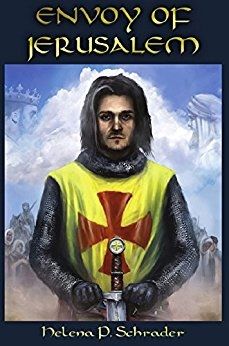
Promo Blitz: Envoy of Jerusalem by Helena P. Schrader


Historical Fiction
Date Published: August 2016
Publisher: Wheatmark

 photo add-to-goodreads-button_zpsc7b3c634.png


Winner of the Pinnacle Award 2016 for Biographical Fiction, the Feathered Quill Award 2017 for Spiritual/Religious Fiction, and a Foreword INDIES Award for Military/Wartime Fiction.

Balian has survived the devastating defeat of the Frankish army at the Battle of Hattin, and walked away a free man after the surrender of Jerusalem, but he is baron of nothing in a kingdom that no longer exists. Haunted by the tens of thousands of Christians now enslaved by the Saracens, he is determined to regain what has been lost. The arrival of a vast crusading army under the soon-to-be-legendary Richard the Lionheart offers hope -- but also conflict, as natives and crusaders clash and French and English quarrel.

Other Books in the Balian d'Ibelin Series


Knight of Jerusalem
Published: September 2014

Balian, the landless son of a local baron, goes to Jerusalem to seek his fortune. Instead, he finds himself trapped into serving the young prince suffering from leprosy, an apparent sentence to obscurity and death. But the unexpected death of King Amalric makes the leper boy King Baldwin IV of Jerusalem, and Balian’s prospects begin to improve.

The Byzantine princess Maria Comnena is just thirteen years old when she arrives in the Kingdom of Jerusalem at her great uncle’s orders to cement the alliance between the two Christian kingdoms in the East. The child wife of a man almost three times her own age, she is despite her excellent education and intelligence little more than a pretty doll in the eyes of her husband. When she fails to produce a male heir for the desperate king, her marriage becomes a gilded prison. Until suddenly the king is dead and Maria finds herself a wealthy widow at just twenty years of age.

Meanwhile, the charismatic Kurdish leader Saladin has united the forces of Islam and vowed to drive the Christians into the sea. While King Baldwin IV—and Balian—struggle to save the Holy Land for Christendom by whatever means they can, the internal rivalries of Templars and Hospitallers, the advocates of offense and defense, and the bitter rivalries of barons threaten to tear the kingdom apart.


Defender of Jerusalem
Published: July 2015

The Christian kingdom of Jerusalem is under siege. The charismatic Kurdish leader, Salah ad-Din, has succeeded in uniting Shiite Egypt with Sunnite Syria and has now declared jihad against the Christian kingdom. While King Baldwin IV struggles to defend his kingdom from the external threat despite the increasing ravages of leprosy, the struggle for the succession threatens to tear the kingdom apart from the inside. In the high-stakes game, one man stands out for his loyalty to the dying king, the kingdom, and Christianity itself. That man is Balian d'Ibelin.

This is the second book in a three-part biographical novel about Balian d'Ibelin, who defended Jerusalem against Salah ad-Din in 1187. The first book in the series, Knight of Jerusalem, was a finalist for the 2014 Chaucer Award for Historical Fiction and a B.R.A.G. Medallion Honoree.


About the Author


Helena P. Schrader earned a PhD in History from the University of Hamburg with a ground-breaking biography of a leader of the German Resistance to Hitler. She has published numerous works of fiction and non-fiction since.

Her Jerusalem Trilogy, set in the Holy Land in the late 12th century, has won critical acclaim.

Contact Links


Purchase Links


Reading Addiction Blog Tours

Monday, July 31, 2017

Promo Blitz: Guardian Angel by William McCauley


Middle Grade / Young Adult
Date Published: 6/2013

 photo add-to-goodreads-button_zpsc7b3c634.png


Markus Simmons, a 13-year-old 8th-grader, wants to hang with the cool kids. When his social studies class begins a Holocaust project, some A-listers befriend him to get him to work with them so they can have access to his Oma, who was in Auschwitz, and he discovers that there are Holocaust deniers in the world, one of whom is in his class. Then someone identifies his Oma as having played a criminal role during the Holocaust, and he has to reconcile his love for his grandmother, his desire to work with the cool kids, and his anger at the deniers and the others who attack his grandmother.


About the Author


William McCauley was born and grew up in the Northern Virginia suburbs of Washington, DC, in a delightful little town called Vienna. His B.A. in German and M.A. in English are from George Mason University, and at the ripe old age of 29, he "ran away from home" to do doctoral work in linguistics at the University of Colorado in Boulder. After two years, his Wanderlust attacked again, and he trekked on down to Miami, FL, where he did more doctoral work at the University of Miami. Then the powers that be at The German School Washington, where he had taught English for six years, tracked him down and asked him to come back. That brought him back to the DC area, where he taught at the German School for another eighteen years. He finished his career in education at the end of school year 14-15, retiring after ten years as a Gifted and Talented Education specialist with Howard County Public Schools in Maryland. Now all he wants to do is write – and read.

Contact Links

Purchase Link

Reading Addiction Blog Tours

Saturday, July 29, 2017

Book Review & Giveaway: Scent of the Past by Erin Marie Bernardo


About the Book

Title: Scent of the Past
Author: Erin Marie Bernardo
Genre: Historical Fiction
Scent of the Past by Erin Marie Bernardo

A secret diary. A forgotten past. Another time.

When people think of time travel, they think of the clichéd manufactured kind. Of giant electronic machines with flashing lights and buttons calibrated to shoot you into the past with one press. But it doesn’t work that way. You need a reason, a connection, and—most important—a link. But you can’t choose when and why you go. That would be too easy, and we’d all be snapping our fingers in hopes of seeing lost treasures of yesteryear. It must choose you.

Close cousins Addison and Elissa live in present day New York City and lead somewhat ordinary lives. When uncertain circumstances surrounding a set of antique perfume bottles sends them back to eighteenth-century France, they must uncover the truth behind their travel.

Disaster strikes when Addison finds herself in a nearly identical situation to a mishap she experienced in the present—the witnessing of a murder and release of a secret. Only this time the truth could destroy the entire French monarchy. With Addison’s head on the line, the young women search for answers before Addison suffers her unlucky fate twice. It is only when they discover the haunting connections to life in the present, that they understand why they both were sent, and why a repeating past...may not always be such a bad thing.

Review of Scent of the Past
History repeats itself, right?   That’s what people say.  And as a history teacher, I have to admit that I at least like the thought that it just might.

Scent of the Past is a story of romance and mystery, about two very different young women, who find themselves transported through time.  Elissa is a simple but sharp-nosed girl who loves antiques and a quiet life.  Addison is wild and adventurous, and likes to live a bit too dangerously.  Addison sees something she is not meant to see, putting her life in peril.  A series of unhappy accidents leads to the breakage of a few priceless perfume bottles and the release of gorgeous scent (from the past, get it?).  This very scent triggers something almost supernatural, and the two women find themselves waking in pre-revolution France, in the court of Louis XV.  Elissa and Addison have to find out how they got there in order to discover how to get back—and Elissa also has to try and corral Addison’s tendency to make poor choices with the wrong men.  And in this case, the wrong man is the very king of France himself, Louis XV.  The two women not only have to find out how to get home, but are also thrust into the middle of an all too familiar royal paternity scandal that could lead to Addison’s demise.

The book has it all.  There’s time travel, and a story rich with delicious historical detail, giving the story the golden hue of French Baroque, and some of the pastel whimsy of a Rococo frolick.   I really want to praise how well this book wove history with narrative, so that the story did not read, at times, like a few paragraphs hastily rearranged from a Wikipedia page.  Author Erin Marie Bernardo did her research, and did a wonderful job creating a believable historical backdrop.  

There’s also romance.  Addison loves dangerous men, and Elissa holds her heart close and closed.  So it stands to reason that Elissa will find love, but then how will that love manage to persist even when spread out over the course of a few centuries?  And how will the concept of past lives and rebirth play to Elissa’s favor?  And will Addison’s wild side end up hurting her beyond repair?

I also have to say that, though the author might not have intended it, I found a bit of feminist hurrah in Scent of the Past.  The story eventually unfolds an impressive truth: that the Elissa and Addison of the past, the ones whose bodies the modern girls have been pushed into, were artisans and entrepreneurs.  Not too easy for women in 18th century France.  Not only that, but they were closely connected to the Queen, a woman whose only real desire is to protect her son.

I was really happy with this book as I read further in.  Scent of the Past is the sort of book that compels you to finish because there is just enough twist and turn to keep the story new and interesting.  Enough that, as a reader, you can’t predict the end of Elissa and Addison’s story.  Even better, you want to see the story through to the end to find out how everything plays out.  It was a wonderfully clever novel that balanced fiction and truth, thrill and romance, toward a delightful and graceful end.

Excerpt from Scent of the Past
Elissa opened one eye. Slowly. Someone was talking to her. Her head hurt, and the room was blurry, so she shut it. The talking didn’t stop. It was annoying, like a pesky mosquito buzzing around your ear right before you fall asleep. She pulled the covers over her head and groaned. She felt horrible.
The woman’s voice was persistent. She spoke quickly: “Bon matin, mademoiselle. Temps de se réveiller.”
Elissa rolled over, hoping to block out the noise and instantly realized she was naked. Oh, my gosh, I’m naked! she thought in fright. Instantly in tune with her surroundings she peeked out from underneath her blanket and surveyed the situation.
First observation. She was in a bed.
Second observation. Already noted, she was naked.
Third observation. This was not her room, and the woman standing at the foot of her bed was clearly not speaking English. Nor was she familiar in any way.
Elissa’s panic meter raised a few notches, and she grasped frantically at her neck. She relaxed. The ruby key was still there. Naked or not, the necklace never came off.
But where am I? she wondered. Whose bed is this? And why can’t I remember anything?
She noted the headache that was descending lower over her forehead. Her eyes made a quick sweep past the bed and around the room. Wherever she was, it certainly was magnificent. Shrouded in a curtain-lined canopy bed, she felt small among the grandness of the space. Although the walls were white, they were heavily decorated in crown molding panels, with intricate cut-out designs cresting the length of each wall. A large stone fireplace faced the bed, and an unlit crystal chandelier hung from the ceiling, which was at least ten feet high or more. A mirror, larger than any table, reflected her baffled face as it sat in triumph above the mantel. Noticing an open door leading to another bedroom, she realized the place only got larger.
Elissa groaned. This must have cost me a fortune. Why didn’t I pick a Holiday Inn?—thinking she might have checked into a hotel. The thought quickly passed before she had a chance to wonder further.
  The woman, who had awakened her earlier, stood scowling at Elissa. She wore some sort of period-style dress and looked like an old-fashioned chambermaid, with a cap and oversized smock. Elissa listened again. It was French. The woman was speaking French! Quite pleased with herself, Elissa smiled at the short lady who was frowning and waving her finger with a tsk, tsk. She hurried around the room picking up this, rearranging that.
“Vous avez dormi. Levez-vous avant qu'ils ne commencent à répandre des rumeurs à votre sujet.”
Elissa listened.  Ahh, French. What a beautiful language, she thought, smiling to herself. She lay there in a sleepy lull, listening on and off while dozing—still feeling a bit drugged. But it didn’t take her too long to think a little deeper. She paused. Wait, why is this woman speaking French?
“My lady, you’ve overslept. Get up before they start spreading rumors about you.”
She gasped. And why do I understand it?


About the Author

Erin Marie Bernardo is an American writer of historical fiction. She has a degree in Communication Studies from the University of Minnesota, and is the author of the time-travel novel, Scent of the Past. A lover of historic places, Erin's novels connect the past with the present.

Erin is currently at work on her second novel, Blackbird's Bounty, set in the bayou of Louisiana – and is actively seeking a home for her children’s collection, Beautiful and Extraordinary Barnyard Stories, based on true events from on her farm. 

Erin lives in Tennessee, but has roots in both Minnesota and Washington State. She is married with two young children. 

Links


Saturday, July 27, 2013

Book Review: Immodest Acts- The Life of a Lesbian Nun in Renaissance Italy by Judith C. Brown


Title: Immodest Acts: The Life of a Lesbian Nun in Renaissance Italy 
Author: Judith C. Brown 
Genre: Nonfiction - History

While perusing the scattered archival documents of a Miscellanea Medicea file housed in the State Archive of Florence, Judith C. Brown came across a series of scattered documents relating to the interrogations of one Ms. Benedetta Carlini, Abbess of the Convent of Mother of God.  Benedetta Carlini was a self-diagnosed mystic, in direct communication with Christ, in fact the very bride of Christ, and the supposed recipient of one of Heaven's highest blessings: the stigmata.  However, due to her own hubris and often abusive and inflated self-importance, the holes in Benedetta's claims began to be exposed.  Beginning in 1619, a series of investigations were undertaken by ecclesiastical authorities to prove the validity of her claims.  Eventually, not only was it proven that Benedetta Carlini had faked her mystic powers, but that she had engaged in a lesbian affair with another nun under the guise of an angelic deity, Splenditello. Brown's novel is so very valuable as a historical source because lesbianism is rarely found in historical sources.  For an early modern (and before) historian, female gender and sexual histories are complicated when found in source material due to contemporary culture and religious beliefs.  Theologians, the writings of whom are by far the most prevalent of documents and sources to be found of the early modern period, had a hard time coming to terms with lesbianism.  Many of them merely believed that no such thing could exist.  Others insisted that the lack of a penis, the only essential part in copulation, made any instance of lesbian sex not sex at all.  There were a plethora of theories about what sex was, what made sex real, and what role both women and men played in the act.  In the preface to Benedetta's story, Brown manages to sum up some of the most important theologians of and before the events of the book, and these theologian's ideas about sex.  For scholars and students of sex and sexuality, Brown's very succinct synthesis of the historical religious views surrounding sex is very useful. Yet let me say that if you are looking for an earth shattering book on early modern lesbian, you will be disappointed.  The "lesbianism" of Benedetta isn't discussed until the very last section when he undergoes her final investigation.  

Really, the book is less about a lesbian nun navigating a very restrictive and strict religious world, and more about a failed mystic who used her power to falsify miracles and lie about the personal relationship she had with Christ and various angels to elevate herself in the monastic community in which she lived.  Beyond the very small spattering of lesbian conduct, Benedetta's life is far more illustrative of a single woman's psychological need for recognition, and to be extraordinary within a community of similarity and similar sacrifice.  After all, how does one show that they are superior to their religious equals?  Show that they are chosen by God or by Christ for miracles and recognition. What I loved the most about the book, though, was the process of investigation underwent by Benedetta.  I loved reading the questions asked, and how she responded.  I loved reading about the miracles she claimed, and then further in the book how the lies behind them unraveled as her fellow sisters began to come forth with the truth.  Again, this is more the story of a woman who rises in ranks within her very small and limited monastic world, has her lies and deceits exposed, and finally falls into obscurity.  As far as microhistory goes, this book is one worth reading.

Friday, July 12, 2013

Book Review: Pompeii by Robert Harris


Title: Pompeii 
Author: Robert Harris 
Genre: Fiction - Historical

I'm still working toward my goal of reading as many books taking place in Ancient Rome as humanly possible in my lifetime. That was what influenced me to pick up Robert Harris's Pompeii. Well that and I have read another novel of his, Imperium, and really loved it. In Pompeii, we enter the Imperial Age, August 79 AD. This is a post-Augustus Roman world, ya'll, so the Roman Empire is expanding with ever increasing passion, and the troubled times of the economic crisis and subsequent invasions is a problem still far in the future by a century and then some. Rome is a powerful, proud, and glimmering empire ruled by the Flavian emperor Titus. Rather than take us through a historical drama about the eruption of Pompeii, Harris prefers to use the eruption as context for another sort of story. His tale centers around a young aquarius named Marcus Attilius who has been sent to care for the Aqua Augusta, one of the many aqueducts that flowed through the Roman world. The Aqua Augusta carried water from Terminio-Tuoro toward the Bay of Naples, supplying water to cities like Pompeii, Misenum, and Nola. The aquarius soon begins to notice strange things taking place. First, the former aquarius is missing. Then there is the strange smell of sulfur in the water. Then the aqueduct begins to stop supplying water. Finally the aquarius takes his team toward Vesuvius to find where the break has occurred and fix it. Of course he manages to anger some very important men in Pompeii, most notably a rich former slave who has made a ton of money in retail following the earthquake of 62 AD, which we now know was a foreshock of the impending eruption. What caused the stopping of the water was a massive underground shift of earth, which is just another thing to foreshadow the impending disaster. The aquarius doesn't realize what is going on until it is too late. Then we are taken through the dramatic moments of eruption, confusion, panic, death, and finally end. The cast of Pompeii also includes some notables. Pliny the Elder makes an appearance, and it is only fitting that he does since he and his nephew Pliny the Younger are the pair that supplied us with the most information about the eruption of Vesuvius, through the Elder unfortunately lost his life due to his insatiable curiosity for the natural world. 

Harris isn't, at least to my knowledge, a historian. He does seem to have a great interest in Rome since he has written at least three books that I know of about the subject. Part of the reason I chose to read Pompeii is because I felt Imperium was not only well written, but paid great attention to historical accuracy without coming across as pompous or loaded with historical detail to compensate for an author's lack of historical training. Harris pays very great attention to historical accuracy, juggling his facts with his prose so that his story isn't inundated with too much detail such that it reads like a textbook. The story is interesting, while at the same time you find yourself unintentionally learning things about Ancient Rome: things about their political system, their various classes, social mobility, architecture, resources, knowledge, etc. It presents itself as a intense and informative story, a snapshot if you will, of what happened just before one of the worst natural disasters of Roman history. It connects us more with the past as not something only isolated to facts, details, and carbonized relics, but we get to see the people and life involved.

Tuesday, July 19, 2011

Book Review: Soldier of Rome- The Legionary Artorian Chronicles, #1) by James Mace


Title: Soldier of Rome: The Legionary
Series: Artorian Chronicles
Book Number: 1
Author: James Mace 
Genre: Fiction - Historical 
Finished: July 19, 2011

Varus, give me back my legions! Anyone who knows anything about Roman history has heard those words. Just the same, anyone who knows anything about Roman history can pick out the important names and places on the back cover alone: the ill-fated Publius Quinctilius Varus; the Emperor Tiberius, successor to Augustus; and Germanicus, glorious military man and the father of the infamously corrupt Emperor Caligula. James Mace’s Soldier of Rome: The Legionary is about what takes place after the defeat at the Teutoburger Wald forest when Rome sets itself up for a retaliatory measure against the Germanic people, led by the heavily applauded Germanicus. James Mace is not a Roman historian, or an historian by training at all. Rather, he is a military man with an avid passion for Roman history. While historians know to be cautious around the world of enthusiasts who usually do not understand issues such as historiography and source creditability, I have always tried to be more fair minded than that. I liked that in the front of the book is a glossary of Roman military ranks, which is a godsend to any and all who know nothing more about the Roman military than the centurion helmet. I cannot wait to start pulling out all of my books about Rome and checking against them. It’s like a great big fun scavenger hunt of historical detail. My favorite kind. I will admit that I too know little about the Roman military in the age of Empire. My experience is with the military structure of the Republic via historians such as Livy and Plutarch, and of Late Antiquity thanks the volumes of respected historians who study the endlessly to either prove or disprove that the Roman military was a dysfunctional machine by the end of the 200s. The complicated structure of the Roman military during its height makes my head spin. Republican that I am, I wonder where the Consuls are and then remember this is a couple centuries after the Punic Wars. So you see, simply having a glossary of ranks and jobs really assisted me in what I read. You know what else impressed me? That when I flipped back to the end of the book I saw a bibliography. Very few writers who dive into historical fiction bother to give proper credit to sources or reveal where they received their historian information. Perhaps they feel as fiction writers they do not have to disclose their sources or give credit where credit is due, but I am a stuffy nonfictionists who feels that things should be credited. Mace lets his readers know that he got some of his information from good ol’ Tacitus who was writing around the turn of the second century CE. I only wish he had elaborated on it and revealed more of the histories he read to recreate his Roman world, and not only cited Tacitus. 

The story begins with the disastrous battle of the Teutoburger Wald, which Rome mourns as military men plan and seek revenge. Loss is not something the Roman military takes lightly, after all. And enemies must be punished or annihilated. The rest of the story takes us through the early stages of retribution and then battle. A young Roman named Artorius has a personal vendetta since his brother was killed in the forest. Led by the young Germanicus, the Romans reenter battle against the Germans who pretended to be allies only to betray them. It becomes an epic battle between the forces of Germanicus, fighting for Rome, and Arminius, who is fighting to preserve his own land and his own people. The book was very exciting. “War” stories are not my thing, but the truth is that I will read anything about Romans. I just dig them. But this book was more than the overtly masculine posturing of male valor, and went beyond the tedious technicalities that bog down a lot of historical writing of the military nature where military maneuvers are described in long and diagram-free detail. I did wish that there was more... Roman context in it. Hidden beneath the surface are important Roman values, norms of respect and rank, and military training. I was also a bit confused about the naming of the characters in the book. But again, this could just be me, as a Republican, understanding Republican conventions of prenomen, nomen, cognomen, etc, as well as what the difference between Claudius and Clodius is. I wanted to be fully involved in not only what it meant to be a soldier, but what it meant to be a ROMAN soldier. One of the most fascinating things about the Romans is how they were. I wish there was more about this, which would place the reader more securely in the Roman world and therefore create a more realistic story. Also, unfortunately, the book needs a good editor. There were many words misspelled and even a mistake on the back cover book description. That alone could cause a lot of people to disregard the book and never give it a chance. It is clear, though, that Mace truly does love the Roman military and has put more research into them than your average person or even hobby historical enthusiast. It was a good and worthwhile read, I think, and puts me one book closer to my ultimate goal of reading every fiction book I can find set the era of the Romans.

Monday, March 1, 2010

Book Review: The Night Battles: Witchcraft and Agrarian Cults in the Sixteenth and Seventeenth Centuries by Carlo Ginzburg


Title: The Night Battles: Witchcraft and Agrarian Cults in the Sixteenth and Seventeenth Centuries
Author: Carlo Ginzburg 
Genre: Nonfiction - History 
Finished: March 1, 2010

In The Night Battles, Carlo Ginzburg looks at a small group of northeastern Italian people from the area of Friuli who claimed to be 'benandanti.' The benandanti, according to their legend, were people born with "the caul," and battled witches to protect the harvest and people, and to heal people bewitched. A second strand of benandanti claimed to be witness to processions of the dead. Using a small set of inquisition documents to do his microhistory, Ginzburg claims that he can reconstruct the progression of benandanti identity from their perspective from those who battle witches to those who are witches. This new identity was imposed, according to Ginzburg, by the inquisitors who used leading questions and other devices such as fear to convince the accused benandanti into altering their confessions to fit the new model of witchcraft, which can be traced through the confession transcripts. The book contains four chapters and an appendix with a few of the transcripts included for reference. Chapter one introduces the benandanti, their beliefs, and the inquisitors; chapter two describes the benandanti who associate with the dead and traces possible links of origin; chapter three returns to the benandanti and the inquisitors, and to the evolution of the benandanti identity; and chapter four sees the conclusion of the benandanti fitting themselves into the accepted mold of witchcraft. There is no way Ginzburg can support, with his available evidence, what the true intentions of the benandanti were when they confessed to witchcraft practices. Was it that they became convinced of their own evil, or simply became indoctrinated out of fear and insistence to change stories to fit what they knew the inquisitors wanted regardless of what they knew to be truth? There is simply no way to know if the benandanti were only saying what they felt needed to be said, or if they actually accepted it as truth. Ginzburg does, unfortunately, make a lot of claims that cannot be substantiated. For example, he tells the story of a woman named Anna la Rossa who he admits never claimed to be a benandanti (35). Yet later on, Ginzburg refers to her as one of the benandanti (41 & 43) without ever proving that she was one. If anything, Ginzburg is merely reasserting that many different beliefs had origins in the same pagan traditions, or that ideas filtered through geographical space. In another case, Ginzburg claims that the trances during which benandanti left their bodies were ointment induced or caused by illness (59). Again, this is not something he can adequately support and therefore cannot state it as unquestionable. Regardless of this, Ginzburg's greatest achievements are two. First, he does a good job in his outlining of the various pagan traditional origins of witchcraft and other cults. Second, he has great success in showing how the inquisitorial process was able to impose beliefs with such effectiveness that people would admit to them even when they knew giving the answer that was desired would surely bring harm to them. It sheds light on the nature of the witch hunts and trials, and the confessions rendered.

Monday, February 22, 2010

Book Review: Christianity and Sexuality in the Early Modern World: Regulating Desire, Reforming Practice by Merry E. Wiesner-Hank


Title: Christianity and Sexuality in the Early Modern World: Regulating Desire, Reforming Practice 
Author: Merry E. Wiesner-Hanks 
Genre: Nonfiction - History 
Finished: February 22, 2010

In Christianity and Sexuality in the Early Modern World: Regulating Desire, Reforming Practice, Merry E. Wiesner-Hanks examines how Christian and Protestant ideas altered and defined sexuality and sexual behavior. The geographical focus of Wiesner-Hanks extends beyond the European continent. She writes about the colonial experience of Europeans bringing Christianity into Latin America, Asia, Africa, and North America, all of which were already inhabited by groups possessing their own native beliefs about sexuality, the changing of which was not done without challenge and compromise. Reconstructing the pre-colonial world of Latin and North American presents a problem, as Wiesner-Hanks notes, because documents are scarce, and as a result she cannot give a complete description of native beliefs. The first three chapters of the book are loosely chronological within topically based chapters, beginning with Christianity before 1500, then moving on to Protestantism, and finally to Christianity and Eastern Orthodoxy. The final three chapters shift to the overseas colonies discussed above. 

In investigating sexuality, Wiesner-Hanks looks at how earlier civilizations influenced later ideas of early Christian writers, and then in turn how these Christian writers shaped opinions on marriage, divorce, fornication, prostitution, sodomy, and witchcraft, to name a few. As Wiesner-Hanks traces how these ideas evolved over time, she also compares them to one another, letting readers see not only how ideas shifted over time, but how Catholicism differed from both Protestantism and Orthodoxy. The chapters are short and succinct, but detailed enough that in every case there is a clear picture of the time and group change. The book is more than a mere generalized overview even though its length is small, though some generalization is necessary and involved, because Wiesner-Hanks looks at specifics and fills her pages with one detail after another. As a result, very little space is given to stories or narratives, which perhaps would have been a nice addition to break up her dense fact-based approach. In fact, it is all too easy to get lost or confused within the barrage of facts and details as, for example, Wiesner-Hanks moves from infanticide to women's bodies to unmarried women and men to craft guilds all in the same two page spread. That being said, there is a lot that Wiesner-Hanks does not say or does not explain, which leaves one with many questions. For instance, when Wiesner-Hanks discusses the Roman model of marriage and sexuality, she fails to mention that the Romans too had their own form of spiritual virginity in the Vestal Virgins, which would be an interesting parallel to Catholic convent life. In another part of the book, Wiesner-Hanks states that religious wars increased the number of people, both men and women, who worked in prostitution (89). Yet she does not explain how that link is made. In many places she describes a situation or a law but then finishes up with the note that the event was rare or the law was rarely enforced, which makes one wonder why it was ultimately significant to mention. It would be a lot to expect one writer to include every detail or point, so the unstated or unanswered in no way mitigates what a good book Wiesner-Hanks has written on the topic of sexuality and religion.

Wednesday, September 30, 2009

Blog Tour & Guest Post: Elizabeth Chadwick (The Greatest Knight)


Welcome to Elizabeth Chadwick, who is here on blog tour to promote her book The Greatest Knight, which you can get in book stores now! It is my absolute pleasure to get to welcome her here today. She was kind enough to grant up here at Morbid Romantic a guest post. Enjoy!

Guest Post
Many thanks to Valorie for giving me air time on her blog! William Marshal, the charismatic star of The Greatest Knight is something of a paradox. He was an ordinary guy when he started out. He was born in the English county of Wiltshire in 1147AD. His father's fourth child, the product of a second marriage. There wasn't much left in the family coffers by way of inheritance by the time William came along. However, his father found an education in the military for him and the young man proved so skilled with lance and sword that he was soon earning a fortune on the tourney circuits of medieval Europe and his talents brought him to the attention of the King and Queen of England. He went on to serve in both their households. He was the tutor in chivalry to their eldest son and travelled extensively throughout Europe and the Middle East. On his return from his travels, he married a wealthy and beautiful heiress and turned his attention to raising a family and helping to steer England through some very troubled times indeed. William's career was stellar by the yardstick of any century, his tale a true one of rags to riches. When he died, his name was renowned throughout the known world. Slowly, through the accumulated dust and detritus of passing centuries, that name became forgotten, except by a few. His life story, written down within a few years of his death in a rhyming family history more than 19,000 lines long, was lost for seven centuries. It re-emerged among a pile of old manuscripts for sale in 19th century France where Historian Paul Meyer saw the poem and realised what a treasure he had rediscovered. He translated it into modern French, but it didn't have an audience beyond academic circles. William Marshal, the greatest knight of the Middle Ages, slept on, seldom noticed, his effigy earning the occasional passing glance from casual visitors to the Temple Church in London where he was buried with two of his sons. There were occasional disturbances. William was dug up and reburied just a few years after his death because Henry III wanted to expand the church, so although the effigy is there, no one is quite sure where William's bones actually lie, although somewhere in the fabric is a given. The church suffered bomb damage during World War II and the effigy was slightly damaged, but survived.

 A few years ago, however, there was a major change. Dan Brown wrote The Da Vinci Code -- anyone not heard of it? The story takes the reader to the Temple church in London and mentions the effigies of four knights lying on the floor of the nave. Suddenly William's tomb was a place of pilgrimage! The first time I visited William at the Temple Church, there was only me and a lady from Australia, who was there visiting a different tomb. The following year, I was joined by an American couple who stood in front of the effigies of William and his eldest son, discussing whether or not one of them had been a crusader. I got into conversation with them and the wife said with a smile "You know why we are here don't you?" I shook my head. "The Da Vinci Code." At that point, the book had only just begun to make waves and the couple were part of the advance guard. I told them who William really was. When it came to my next pilgrimage a further year on, the Temple Church was by now packed with tourists embarked upon the "Da Vinci Code tour" and William and his sons were the centre of attention. There must be thousands of photo albums round the world featuring snapshots of proud visitors crouched beside the effigy of one of the greatest men England has ever produced, but all these people know is that he's one of their tick boxes on the Da Vinci Code experience. These days William and his sons have had to be protected from all the attention by rope barriers. There were none when I first went to pay my respects. I find it very fascinating. William was an unknown who became famous and then forgotten again. Now he's famous but anonymous. I am hoping that The Greatest Knight is going to change that state of affairs big-time! 

About the Author Elizabeth Chadwick lives near Nottingham with her husband and two sons. She is the author of 17 historical novels, including Lords of the White Castle, Shadows and Strongholds, A Place Beyond Courage, The Scarlet Lion, the Winter Mantle, and the Falcons of Montebard, four of which have been shortlisted for the Romantic Novelists' Awards. Much of her research is carried out as a member of Regia Anglorum, an early medieval re-enactment society with the emphasis on accurately re-creating the past. She won a Betty Trask Award for The Wild Hunt, her first novel.

Wednesday, July 8, 2009

Book Review: The House of the Vestals (Roma Sub Rosa, #6) by Steven Saylor


Title: The House of the Vestals
Series: Roma Suba Rosa
Book Number: 6
Author: Steven Saylor
Genre: Fiction - Historical
Finished: July 8, 2009

In The House of the Vestals, Rome's best finder Gordianus is back in a series of short stories full of political intrigue, murder, theft, and mystery. Set in between the novels Roman Blood and Arms of Nemesis, The House of the Vestals update readers on what Gordianus has been up to in the years that pass between the two books. In Death Wears a Mask, Gordianus tracks a murderer who targeted an actor in between play scenes. Bethesda tells the story of a King's missing treasure in The Tale of the Treasure House. Rich Patrician Lucius Claudius, who soon becomes a close friend of Gordianus, first comes to him with a mystery about a will, a supposed dead young man, and a sighting of the supposedly dead man in A Will is a Way. The Lemures is about two separate households plagued with spirits of the dead, which Gordianus must figure out even as he has his own wits scared out of him. Gordianus' life is once again put in danger when he is sent to ransom a kidnapped young boy from pirates in Little Caesar and the Pirates. The Disappearance of the Saturnalia Silver once again involves Lucius Claudius and his missing Saturnalia gifts-- this one is solved by Bethesda. In an attempt to get away from the chaos of the city, Lucius Claudius and Gordianus escape to the country in King Bee and Honey, but death and mystery follow. To entertain Lucius Claudius, Gordianus tells him the story of The Alexandrian Cat and how he saved the life of a fellow Roman in Egypt after the murder of a sacred cat. Finally, in the namesake story, The House of the Vestals, Gordianus must help Cicero by solving a murder that happened in one of the most sacred buildings of Rome. I was very eager to read this book because Roman Blood is such a good book and now one of my favorites.

When I got The House of the Vestals, I didn't know it was a novel of short stories until I opened it up. Each story is short enough that it is to the point with no tangents or intertwining plotlines to stray from the one major plot focus, the mystery. Novels can get complex because they require a lot of build up and climax, as well as a lot of details, but short stories need very little of any of that and can get to the point quickly. I like short stories because they are like instant gratification, plus you can sit down and read one in between other things. Sometimes my attention span needs a break. There are also some good character developments within the short stories. First, there is the introduction of Lucius Claudius, a new character. Second, we get to see how Gordianus and Eco are progressing in their relationship, which is almost father and son. Third, the story Little Caesar and the Pirates tells of how Gordianus got his bodyguard Belbo. And fourth, Bethesda once again shows herself to be more than a mere slave-- indeed, she is quickly showing herself to be the equal of Gordianus and very perceptive. All in all, I just really like Gordianus-- he is realistic, witty, imperfect, and practical. Like Roman Blood, the history is rich and subtle, not shoving facts in your face so much as using them for setting but teaching you about the time nonetheless. If you like short stories and Roman mystery, there is no way that you won't like The House of the Vestals.